National Night Out Poster Contest winners
|
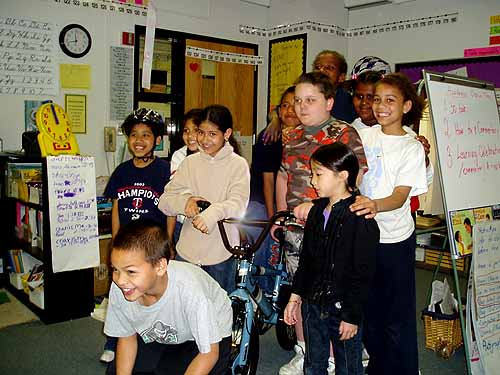
Above: National Night Out Poster Contest
winners from Dayton’s Bluff Elementary School and some of the
prizes. Photo by Karin DuPaul
Below: Joseph Hamm’s winning poster.
|

|
The winners of the National Night Out Poster
Contest have been announced. Children from Dayton’s Bluff Elementary
are Joseph Hamm and Rafael Roman, third Graders in Ms. Kressin’s class.
From the American Indian Magnet school winners included Amoses Holton,
Pa Foua Yang, and Pa Kou Yang. Other Dayton’s Bluff winners
included Stephanie Vang, Blong and Peter Vang. Prizes included
bikes, bike helmets, DVDs, soccer balls and gift certificates.
All children who entered received a Student Achievement Award, a
complimentary Child’s meal from Old Country Buffet and Ice Cream from
Culver’s.
A special thanks goes to all the business that donated
prizes for the contest. They include Boehm’s Bicycles, Best Buy,
Chanhassan Dinner Theater, Culver’s, Gloria’s Jewelry, Grand
Performance, Holiday Inn (East Saint Paul), The Little Oven, Old
Country Buffet, Padelford Packet Company, Perkin’s, Play It Again
Sports, Science Museum of Minnesota and Target.
The contest’s purpose is to get more people involved in
National Night Out events on Tuesday August 3, 2004. National Night Out
is designed to heighten awareness of crime and drug prevention efforts,
to generate support for and participation in local anticrime programs,
to strengthen neighborhood spirit and police-community partnerships,
and to send a message to criminals that neighborhoods are organized and
fighting back.
Each year families, neighbors, neighborhood groups,
and block clubs celebrate National Night Out with a variety of
events. Neighbors spend the evening getting to know neighbors.
Talk to your neighbors and find a way to celebrate National Night Out
that fits your neighborhood.
A brief Hmong history lesson
By Nachee Lee, Executive
Director, Dayton’s Bluff Community Council
According to Hmong historians and studies, about five
thousand years ago the ancestors of the Hmong lived along the lower
reaches of the Yellow River in China. Wars and persecution from other
groups forced the Hmong to flee their homelands southward to Indochina;
now consisting of Thailand, Laos, Vietnam, and Burma. The Hmong
left China around the end of the nineteenth century to settle near the
tops of mountains in Indochina.
The journey of Hmong people from China to Indochina was
long, hard and difficult. The long journey resulted in hardship,
changes, sacrifice, starvation, and death. According to Hmong elders
and folktales, during this journey many Hmong faced punishment and
separation. Families headed different directions. They had to
walk over steep mountains and through narrow gorges. Many people,
particularly the elders, could not survive the long journey. Many died
and were buried along the way. Women and children were exchanged and
traded for food. Those who studied and had knowledge about Hmong
history know this experience as the “Trail of Tears”. In today’s
Hmong death ceremonies people still mourn this. Despite all of
these hardships, many Hmong had survived and reached their destinations.
The Hmong became strong fighters for the
United States against the Communists from 1960 to 1975. For this
period, life for the Hmong was not the same. They were constantly
moving again and facing a situation similar to the trek from China to
Indochina. Families lost members, wives lost husbands, and
children lost aunts and uncles. As a result of supporting the United
States in this war about thirty thousand Hmong died.
The situation got even worse when the United States
decided to pull out their troops from Vietnam and Southeast Asia in
1975. As soon as the United States pulled out, Laos fell to the
Communists, and then Pro-American Hmong became a favorite target for
the Communists. Pro-American Hmong villages, houses, and fields were
burned down, the animals were slaughtered, and Hmong leaders were
chased down and killed.
Luckily, many Hmong managed to flee through the jungles of
Laos and crossed the Mekong River to Thailand for a short-term refuge.
They waited in refugee camps to be placed in countries that would want
to take them in. The United States, Canada, and France were among the
first to accept many Hmong families to their countries. These
countries are also first choices for most Hmong because of their
affiliation in Laos. Thanks to all the churches, organizations, and
family sponsors, today there are large concentration of Hmong in
California, Minnesota, Wisconsin, Colorado, and Carolina.
The word “Hmong”, to the Hmong, means “blooming
fertile.” In China, Hmong is known as “Miao” meaning
“agriculture”, to identify the first group of people who knew how to
grow rice and corn in the rice paddies.
Enter Dayton's Bluff garden
contest
Greening Dayton’s Bluff will hold a garden contest this summer. Be on
the look out for outstanding gardens in your area. Then either
email Karin@DaytonsBluff.org or send your nomination to: Dayton’s Bluff
District Forum, 798 East 7th Street, Saint Paul MN 55106. Include
the address, name of the gardener, description of garden, your phone
number and the phone number of the gardener. The judging will be in the
late summer.
We are also looking for judges for the garden
contest. If you are interested call Karin at 651-772-2075.
Visit Mounds Park for the 4th of July
Indian Mounds Park will be a great place to spend
the extended Independence Day weekend.
Watch The Grand Flotilla of Grand Excursion 2004
arrive in St. Paul on the afternoon of July 3rd. Nearly a dozen
paddlewheelers and spectacular boats, along with an “armada” of
pleasure craft, are expected to be in full view from Mounds Park
between 1 and 3 p.m. as they head for Harriet Island.
Of course The Taste of Minnesota fireworks will be visible
from the west end of the park each night, July 1 – 5 at 10:15 p.m. with
a special display on July 3 to welcome the Flotilla.
Grocery Give-Away
A Grocery Give-Away will take place on Saturday, July 17 from 10:30 a.m. to
noon at
Mounds Park United Methodist Church,
Euclid and Earl. Free produce, dry goods and bread items will be
given to anyone who can use them. No registration or sign-up is
necessary.
Sponsored by United Methodist churches on St. Paul's east side.
Charlotte's
Web auditions at the Mounds Theatre
The heart-warming classic Charlotte’s Web comes to life on
the stage this summer at the Mounds Theatre as part of the newly formed
Performing Arts Youth Conservatory.
Auditions are open to children in grades 4 through 12 and
will be held on Monday July 5 and Tuesday July 6, from 6 to 9
p.m. Registration is not necessary. Simply show up.
Actors should prepare a monologue and a short musical
passage.
Rehearsals will run July 7 through August 18.
Performances are August 19 through 22.
Youth who are cast will not only rehearse the production
but will also participate in workshops about acting, dance, voice and
auditioning. There will be a $35 registration fee for students
accepted into the program.
If you are interested in helping with costumes, lights,
sets or the many other aspects of the play, please contact the theatre.
The Mounds Theatre is located at 1029 Hudson Road, Saint
Paul, MN 55106. For more information please call 651-772-2253 or
visit their website at www.moundstheatre.org.
Swede Hollow Cafe changes
hands
|
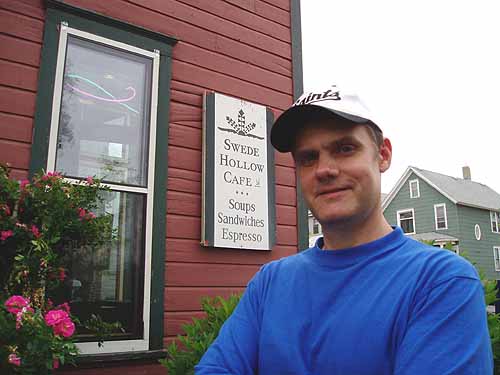
Wes Linstrom is the new owner of the Swede
Hollow Cafe. Photo by Karin DuPaul
|
Wes Linstrom is the new owner of the Swede Hollow
Café at 725 East 7th Street. Wes plans to keep things about the
same and in time increase the items on the menu and the café
hours. Wes comes to the café with years of restaurant experience
and is happy to have the opportunity to own the Swede Hollow
Café.
The Swede Hollow Café opened its doors on July 1,
1996 and is a well-known destination drawing in people from all over
the Metro area. Newspaper and magazines have featured articles about
the excellent food served at the café. In nice weather you can
dine in the gardens next to the café. They are open Monday
through Friday from 6:30 a.m. to 3:00 p.m. and on Saturdays from 8:00
a.m. to 2:00 p.m. Next time you go to the Swede Hollow Café say
“Hi” to Wes and welcome him to the neighborhood.
Learn
how to start your own business
Have you ever wanted to start your own business? Or, have
you started one and are realizing that you need more education to make
it successful? If so, sign up for the Dayton’s Bluff Neighborhood
Entrepreneur Training and Support Program. This program helps start-up
and young businesses on the East Side. All East Side entrepreneurs are
welcome. East Seventh Street is a good place to have your
business. There are a number of storefronts available now. Also check
out the Earl-Hudson area if you are looking for business space.
The next class will start in September 2004. Classroom
training is eight weeks and includes topics such as operations
management, marketing, financial management, and preparing a business
plan. In addition, the class provides approximately eight hours of
one-to-one assistance with creating a successful business. Those who
successfully complete the course and locate their businesses in target
neighborhoods are eligible for ongoing business support services.
Some of the businesses that people who took the
course have started include graphics, photography, food service,
restoration of wood furniture and works of art, custom floral design
for weddings and events, and exterior and interior painting. The course
is sponsored by the Dayton’s Bluff Community Council and the
Neighborhood Development Center. There is a small registration fee
based on a sliding fee scale. Class size is limited so get your
application in today. Please call Karin at 772-2075 for
more information or an application.
Dayton's Bluff Take a Hike
Dayton’s Bluff Take a Hike meets on the first
Saturday of every month at 10:30 a.m. in Indian Mounds Park at Earl
Street and Mounds Blvd. Join us on
July 3 for the next hike.
We hike from Mounds Park through Swede Hollow Park and
then walk the length of the Bruce Vento Recreational Trail to its end,
near Phalen Park.
The hike is about 6 miles with some moderately rough
terrain. Trans-portation will be available near Johnson Parkway
and Maryland to return to Mounds Park or you may hike back if you
wish.
Join recreational trail supporters and explore this
recreational trail. The paved trail runs from East 7th Street and Payne
Avenue through Swede Hollow to Phalen Park. Dayton’s Bluff Take a Hike
started in December of 1990 and over the years hundreds of people have
attended these events.
For more info, call 776-0550.
Life along the river
By Mary Petrie
After vandals stole the Indian statue on Mounds Boulevard,
our family van was one of those vehicles slowing down in front of the
recovered, mutilated landmark. We shook our heads over the
stubs where arms once arched skyward, full of triumph and respect.
My mother was along for the ride. She pointed to the
statue. “Oh! I saw this on the news.”
My eight-year old son bolted from his standard slump,
instantly energy and attention. “Our neighborhood was on
TELEVISION?”
Mom nodded and recapped the 10:00 news segment.
Stryker jammed his hands in his pockets. If he’d
been walking, he would’ve swaggered. “We’re on TV. Awesome.”
We left the Indian behind and drove on.
When we moved to Mounds Park last year, our friend Paul
offered a helping hand with furniture and philosophy.
If we wanted to get to know our new neighborhood as well as the old, he
advised, attend to foot traffic. You get the flavor and feel for
a community on the ground, in the minutiae of day to day living, as
opposed to the public and polished narratives of newspaper, radio, and
TV.
On the subjects of city life, cold beer, and sea shanties,
Paul is rarely wrong. So I hit the streets. Unfortunately,
Mound Street is only four or five blocks long, depending on how you’re
counting. Not much movement except for immediate neighbors and
dog-walkers. The boulevard and river bluff are another
story. You’ll almost always find company on the long
stretch of sidewalk running alongside the bluff, from Pacific to the
tip of Burns.
I anticipated striking up conversation with the folks
huffing up the hill or sitting on benches.
Notoriously gregarious, I nonetheless found myself unable to initiate
contact. Each person – from the rheumy-eyed man standing
between the burial mounds, listening; to the teenage girl pointing out
trains to a fascinated toddler; to the tense-looking woman who hauled
paintbrushes, canvas, and easel to the top of the hill – seemed
distant, wrapped in a sense of seclusion that’s unusual to come by in
public spaces.
Before long, I understood. People don’t come to the
Mississippi River bluff to be alone – you can do that in your own
kitchen (or a locked bathroom, if necessary. Ask any mother of small
children). People come to the bluff to be with the river.
The Mississippi and her supporting cast of characters constitute the
tenor and tone of this neighborhood as much as the people who share the
sacred spaces.
While this pronouncement probably isn’t coming as much of
a surprise to longtime residents (or maybe even to you speedier
learners), I was not prepared for landscape to become such a large part
of my daily life. Until living in Mounds Park, I had an
offhand vision of the river as one more obstacle to be crossed, sort of
a like a long, leaky highway.
Now, daily, I marvel, grounded to the earth in new
ways. Foot traffic here can mean the occasional deer.
Twice, I’ve watched them bound through our backyard; frequently, I see
them nose out of the trees near the bluff. Geese peck and
squawk. I’ve stood below herons and hawks. Even the
squirrels here strike me as more exotic—all the jet-black variations
appear to have landed in this neck of the woods. On a wet
spring morning, the prairie is alive with birds, grasshoppers, mice,
and rabbits; the air is sweet with lilacs. Yarrow, coneflowers,
and wild roses ready stem and petal for their turn to shine.
Below, trains and boats still rely on their natural lifeblood, just as
they did decades ago—the river. The city rises and pulses out of
the water, dependent and dominant at once. Standing in the
middle of the burial mounds—with the grass swaying and singing, with
the expanse of water and sky – I can believe that what is elemental
holds spirit. Yes, this can be called sacred space.
Clearly, others share my perspective.
A couple of days after the Indian statue was restored to
its rightful spot, a pot of yellow flowers appeared underneath
it.
I don’t know if the homeowners set out the flowers.
Maybe. But I like to think that someone like me, a neighbor—part
of the foot traffic—stopped to welcome a friend home with a gift of
color and life. Of course, that little pot of flowers won’t ever
make the news. But for those of us on the ground, that bright
smattering of yellow in front of the statue offers the real tone and
tenor of Mounds Park.
Mary Petrie is a Mounds Park
resident who will be writing about life in the neighborhood and ways to
improve the quality of family life.
Kinetic Kitchen Dance
Series starts July 3rd at Mounds Theatre
The Mounds
Theatre and presenter Sarah LaRose invite you to attend a
new tradition in dance, the “Kinetic Kitchen”. This dance series
will
showcase dances and choreography by professional artists from the Saint
Paul and Minneapolis arts communities.
To kick off this event, we are excited to present CAAM
Chinese Dance
Theater, the Christopher Watson Dance Company, Matt Jenson’s New and
Slightly Used Dance, and solo dances choreographed by Stacy Pottinger
and Sarah Hauss. The first of eight performances to be presented
at
the Mounds Theatre in the next year will take place on Sat. July 3rd at
8 p.m.
We also look forward to showcasing youth performers in our
“Kinetic
Playground” dance series. The first “Kinetic Playground” will
take
place on Sat. Aug. 7th. This concert will showcase youth
performers
from the Saint Paul, Minneapolis, Hastings and Burnsville communities.
We are excited to bring Ballareteatro Dance Theatre, Youth Dance
Ensemble, Riverbend Dance Arts and CAAM Chinese Dance Theater to Saint
Paul audiences.
The “Kinetic Kitchen” and “Kinetic Playground” dance
series offers a
wonderful opportunity for youth, emerging choreographers and
established dance companies to come together to present their artistic
visions. Sarah LaRose, presenter, looks forward to opportunities
for
both performers and audiences to enjoy dance at the Mounds Theatre for
years to come. Audiences from throughout the metro area will now
have an ongoing opportunity to
|

view and enjoy dance in the Dayton’s Bluff
neighborhood.
Tickets for all “Kinetic Kitchen” and “Kinetic Playground”
performances are $10 each. Tickets may be purchased at the door
the night of the first performance on July 3rd, 2004.
Reservations for these performances are being taken by the theatre;
please call 651-772-2253 for details.
The Mounds Theatre is located at 1029 Hudson Road.
Please visit www.moundstheatre.org for more information about this and
other events sponsored at the Mounds Theatre. Visit
www.leavehome.com/kinetic for more information about the series.
|
Do it yourself:
Discovering your home's history
By Nick Duncan
When Amy Handford agreed to show her home on the Dayton’s
Bluff Home Tour last month she wanted to include a brief history of her
house for tour attendees. But where to begin? Handford was
fortunate in that her home had been included in a historical review of
the Dayton’s Bluff district done in the early 1980s, so she knew
something of it’s past. “When we bought the house all we knew was
the name of the family that had built it and the year it was built, “
said Handford. “The historical review gave us some very good
information but nothing too detailed. I talked to some family
members of the past owner and they gave me some information but I
wanted to know more.”
Like Handford, many of us would love to know more about
the history of our homes. When was it built and by whom?
How much did it cost to build? What did the original owners do
for a living? Where were they from? What did your home look
like 100 years ago? Was the second floor layout always that way
or did someone do some remodeling at some point? Was that back
bedroom always a bedroom or did it used to be a pantry? Was that
garage originally a horse barn or was it built later? Remember,
there were no cars 100 years ago. By researching the history of
your home it may be possible to answer some of these questions.
Dayton’s Bluff neighborhood
Most of the homes in our neighborhood are built on a tract
of land originally developed for residential use by land speculator
Lyman Dayton in the 1850s and 1860s. Dayton’s Bluff quickly grew
from a small colony of well-to-do businessmen, who built large homes
along the ridgeline overlooking downtown St. Paul, to a mixed income
development with homes of a wide range of styles and sizes
stretching well eastward from the river bluffs.
If you live in Dayton’s Bluff chances are that your home
was built in the later part of the 1800s or early in the 1900s with the
oldest homes generally being located nearer the Bluff itself. In
the late 1800s Dayton’s Bluff was considered one of the preeminent
neighborhoods in St Paul. Many of the city’s most wealthy and
influencial citizens called Dayton’s Bluff home. This included
Railroad magnet James J. Hill who resided on Dayton’s Bluff in the
1890s while his famous mansion on Summit Avenue was being
completed. At the same time, the 1880s saw St Paul’s
population explode. An influx of immigrants from Germany,
Ireland, and Scandinavia flooded into the city. Many of these new
Americans also built homes on Dayton’s Bluff, although, at a much more
modest level than their wealthy counterparts.
The diversity in home size and home style is easily
Dayton’s Bluff’s most noticeable architectural characteristic.
Take a quick drive down any street in our neighborhood and it will
quickly become apparent that Dayton’s Bluff is truly a melting pot of
architectural style. One notices that on virtually every block
there are one or two large Victorian style homes sandwiched between a
variety of smaller houses in an assortment of architectural styles and
characteristics. But, regardless of your home’s size or
grandeur, there is a very good chance that it has a rich and
interesting history.
Getting started
So how do you begin your house history research?
There are a variety of resources available right here in St
Paul. We talked to some experts and have outlined some
resources for beginning your research.
Building permits
“The best starting point when researching your home’s
history is with the building permit,” says Jim Sazevich, St Paul’s
preeminent House Historian. From 1883 forward every house built
in the city of St Paul required a building permit. 90% of these
permits still exist. The building permits include information on
everything from dates of construction, original dimensions of the
house, and additions to the house. The Ramsey County Historical
Society now holds the permits. But, in order to obtain a copy of
the original building permit for your home, you must first get the
Building Permit number and year of construction from the City of St.
Paul License-Inspections and Environmental Protection Office (LIEP) at
350 St. Peter Street, Suite 330, in downtown St. Paul.
Once you have obtained the Building Permit number and date
call 651-222-0701 to request the copy. The Ramsey County
Historical Society charges a $12.00 fee for each permit copy you
request.
Abstracts/Deeds
Another important source for discovering the history of
your house is the home’s abstract. The abstract is the document that
records all legal transactions associated with a given property. A lot
of valuable information can be gained just by examining the
abstract. Not only can you find out who owned a certain house,
when and for how long, but many times you can also find out who built
the house and if and/or when it has undergone extensive
renovations. It’s a very good source to begin to find out more
about the people who once inhabited your home. Most people were
given the abstract of their home upon its purchase. If you’re a
homeowner you already have access to your homes abstract. If your
home does not have an abstract and is Torrens property, you can look up
documents pertaining to the history of your home and lot at the Ramsey
County Property Records and Revenue Department at 50 West Kellogg Blvd.
City directories
There are city directories for St. Paul going back as far
as 1856. These directories are far more than your run of the mill
telephone books. They list the names of all the adults in a
household along with their professions. From 1929 forward the
city directories even “cross index” so one can look up a listing by
address not just the last name of the occupant. These directories
are a great source if you want to know more about the past owners of
your home. The Minnesota Historical Society Library has St Paul
Directories going back to the 1860s. They also have an early but
selective directory, the Dual City Blue Book, which also has a reverse
index. The Library has those directories for the years
1885-1923. The MNHS Library is located in the Minnesota History
Center at 345 Kellogg Blvd and is open to the public. It is the
single best resource for discovering your home’s history.
Census records
If the city directories don’t provide enough information
on the past residents of your home maybe it’s time to check out the
census records. Every ten years from 1790 forward there was a
federal census taken across the county. For the years 1850 to
1930 these census records are on microfilm at the Minnesota Historical
Society Library.
Tracey Baker, MNHS Librarian and resident House History
expert encourages researchers to look at the census for their
house. “In the census you’ll learn about how many people lived in
your house, where they and their parents were born, their ages and
occupations, “ says Baker. “It’s amazing to discover that a house
you consider cozy was once a home to a family of eight children.” She
adds.
Plat/Insurance maps
Over the years there has been a number of detailed maps of
St Paul. These maps, mostly made by insurance companies like the
Sanborn Company, include detailed drawings of every structure within
the city. This includes the Dayton’s Bluff area. If you
want to see the footprints of your home 100 years ago, if you want to
know if the porch was originally open, this is the place to look.
Again, these maps are available on microfilm at the MHS Library.
Newspapers
Over the years St Paul has been home to a variety of
newspapers. This includes citywide papers along with local
community papers. Sazevich points out that included in the pages
of many of these newspapers are a variety of articles that can be very
helpful in your home history research. Events such as births and
deaths are recorded and, in many cases, new buildings and even the
doings of certain local architects were reported on. Again, these
papers are available on microfilm at the MNHS Library.
Photos
The Minnesota Historical Society has photographs of many
houses. To search the collection you can visit the Library or
view their Visual Resources Database online (http://collections.
mnhs.org/visualresources). The Ramsey County Historical Society
also has some photographs of the neighborhood. If at all
possible, talk to previous owners, neighbors or long time Dayton’s
Bluff residents. There’s a good chance your home made the
background of at least a couple of pictures in someone’s family photo
collection.
This certainly is not a complete list of sources for
researching your home’s history but hopefully it will offer a good
stepping off point for you to begin your work. Most of
these resources are free and open to the public. The Minnesota
Historical Society Library is open Tuesday 12-8 and Wednesday thru
Saturday 9-4.
Dayton's Bluff Rec Center
July and August Events
800 Conway St.
Director: Jody Griffin jody.griffin@ci.stpaul.mn.us
This is a partial list of activities. For a complete
list and more information and registration visit the Dayton’s Bluff
Recreation Center at 800 Conway St., call 793-3885 or visit http://www.ci.stpaul.mn.us/depts/parks.
TOTS ARTS & CRAFT TIME
(Ages 3-5 yrs.)
Fridays, July 16; 10:30-11:30 am; $.50/wk; 4 sessions
PARENT & TOT PLAY TIME
(Ages 5 & under)
Mon., Wed. & Fri.; 10 am - 12 noon; Free; On-going
RUN, JUMP & THROW
(Ages 3-5 yrs.)
Mon., June 21-July 25; 11 am - 12 pm; $12; 6 sessions
ARTIST WORKSHOP
(Ages 8-16 yrs.)
T/Th July 12; 10 am - 12 pm; $60; 12 sessions
BREAKDANCING
(Ages 9-17 yrs.)
Mon. & Wed., July 12; 1:30 - 3 pm; $30; 12 sessions
TEEN CLUB
(Ages 9-14)
Tues. & Thurs.; 5-7 pm; Free; Ongoing
EAST SIDE ARTS COUNCIL ART MOBILE
(Ages 6-12 yrs.)
Tues., Aug. 3, 10, 17; 1 - 3 pm; Free; 3 sessions
MOVIE THEME WEEK
M-Th; 3 - 5 pm; Free
July 12-15 Fish week
July 26-29 Documentary week
Aug. 9-12 Comedy week
Aug. 23-26 Cartoon week
SPORTS 101
(Ages 16 & up)
Week 1 - Baseball; Week 2 – Basketball; Week 3 –
Football; Week 4 – Soccer; Week 5 – Golf; Week 6 - Hockey
Mon., July 12; 6:30 - 7:30 pm; $4/wk; 6 sessions
WET, WILD CRAZY WATER DAYS
(Ages 5-12 yrs.)
Th, July 15 & Aug. 19; 1 - 2:30 pm; Free; 2
sessions
LET’S MAKE AN INSTRUMENT
(Ages 4-7 yrs.)
M-Th, Aug. 9-12; 9:30 - 11:30 am; $8/wk or $2/day; 4 sessions
BASKETBALL
M-Th, July 19-22; 1 - 3 pm: 7-11 yrs.; 3 - 5 pm; 12-17 yrs.; $20; 4
sessions
VOLLEYBALL
M-Th, July 5-8; 12 - 2:30 pm: 13-17 yrs.; 2:30 - 5 pm: 8-12 yrs.; $20;
4 sessions
MULTI SPORT LACROSSE CAMPS (Lacrosse, Flag Football,
Basketball)
M-Th, Aug. 2-5; 9 am - 12 pm: 6-9 yrs; 1 – 4 pm: 10-14 yrs.; $56; 4
sessions
FALL SPORTS REGISTRATION
Soccer, Flag Football registration will be July 6-16. Ages 5 to
14. Age groups: 6-8 yrs., 9-10 yrs., 11-12 yrs, 13-14 yrs.
Tackle Football registration will be held at Conway Rec. Center
501-6343 and at Wilder Rec. Center 298-5727.
SHOWBOAT PRESENTATION OF “THE MOUSETRAP”
Tues., July 20; 1:30 - 5 pm; $17
FIELD TRIPS
COMO ZOO POOL AND PICNIC
Fri., July 9; 9:30 am-3:30 pm; Fee: $5
MN LYNX BASKETBALL GAME
Wed., July 14; 11 am-3 pm; Fee: $7
INDOOR ARCHERY RANGE
Fri., July 16; 10 am-3:30 pm; Fee: $12
CASCADE BAY WATER PARK IN EAGAN
Fri., July 23; 10:30 am-4:30 pm; Fee: $11
STEPPING STONE THEATER
Fri., July 30; 11 am-1 pm; Fee: $7
Historic Leithauser Lofts
The Leithauser Building at 800 East 3rd Street was
recently sold to Michlitsch Builders who plan to totally upgrade the
building into six one- and two-bedroom condominiums. They will build a
garage on the side lot with two more condominiums above it. The name of
the project is Historic Leithauser Lofts.
The Leithauser Building had been vacant and for sale for a
number of years. When architect Bob Roscoe was leaving a meeting
at the Powderhorn Community Council in Minneapolis he asked Leon
Michlitsch if his company would be interested in renovating a historic
building in Saint Paul. Roscoe and Michlitsch have known each other for
over twenty years and worked together on a number of projects. Leon and
his brother Marvin are the owners of Michlitsch Builders, which has
been renovating and building homes for over twenty years. Roscoe is no
stranger to Dayton’s Bluff. He has worked with Historic Saint
Paul and on a number of Dayton’s Bluff historic homes projects. Roscoe
and Karen Gjerstad are the architects for the Historic Leithauser
Lofts.
A little history about the Leithauser building: Dayton’s
Bluff resident and architect/contractor Matt Leithauser built the
Victorian building in 1887. The building had two commercial businesses
on the first floor and apartments on the second. Matt Leithauser was
head of the contracting firm of Leithauser, Fortmeyer, and Hilger. Matt
and his two brothers immigrated to Saint Paul from Germany. The
Leithauser families lived at 893 and 895 Fremont for many years.
Construction on Historic Leithauser Lofts should begin in
July and be completed in February 2005.
Meet
Joanna, your new Dayton's Bluff Librarian
|
|
This article was originally
featured in The Friends of the Saint Paul Public Library Newsletter,
Summer 2004. It is reprinted here with permission.
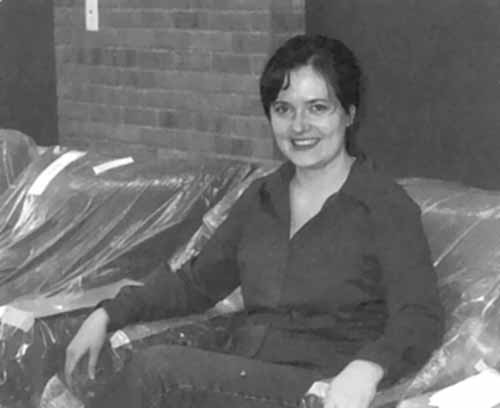
You may recognize Joanna Brookes as the librarian who
drove the Bookmobile. She will now be the friendly face greeting you at
the new Dayton’s Bluff Branch Library.
Joanna is a third-generation librarian. “When I was a
little kid, I spent a lot of time in libraries. My mother is a
librarian-she’s now a law librarian in Hennepin County. My grandmother
was a children’s librarian in Wichita, Kansas. I guess libraries are in
my blood.” She received her Masters in Library Science from the
University of Wisconsin, and began working at the Saint Paul Public
Library in 1997.
In 2001, she left to live in Manchester, England for a
year with her husband, working in libraries overseas as well. “It’s a
little different there. For one, there aren’t as many modern amenities
as we have here, like public internet access. They also don’t
have as many new books, but they did treat them with slightly more
care, using thicker book jackets, not as disposable as ours.”
What does she miss most about England? “Their amazing
gardens. And the countryside.” Not that she drove; she let her husband,
a native Brit, handle the driving. “I was petrified of driving there,
but after driving the 2-ton, 30 foot-long Bookmobile, I think I might
be able to handle it now.”
She and her husband moved back because she missed Saint
Paul, and better opportunities were available here. They moved
into their new house just a year ago.
On her bookshelves, you’ll find titles by Bill Bryson, Po
Bronson, Anne Tyler, and Ian McEwan. “And mysteries. Anything
suspenseful.” In good weather, you might find her working in her
garden. “We inherited the garden with the house. And since I haven’t
managed to kill anything off, I’m willing to keep working at it.”
She’s also a novice chef, enjoying making pizzas from
scratch and trying out new soup recipes. “I picked up this daily
soup cookbook from the library’s discard pile. It just looked like an
interesting book. I haven’t had a bad recipe yet!” Especially tasty,
she says, are the recipes for the Mexican tortilla soup—really
spicy—and the corn chowder.
As the new Dayton’s Bluff manager, Joanna is most excited
about the partnership with Metropolitan State University and the chance
to work under the same roof and share the collection. She’s looking
forward to meeting the families and students of Dayton’s Bluff.
What is something that might surprise people about
librarians? “We don’t expect people to be quiet all the time!” So
come and visit the new Dayton’s Bluff branch, and don’t be afraid to
shout out a warm welcome to the new library manager.
Summer Reading Fun
at the new Dayton’s Bluff Branch Library
645 E. 7th St.
651-793-1699
Wednesdays at 10:30 a.m.
JULY
July 7: Half Pint and Oscar (clowns)
July 14: Amazing Jeffo (magic)
July 21: Diane Gasch (puppets)
July 28: Black Storytellers Alliance
(storytelling}
AUGUST
August 4: Norm Barnhart (magic)
August 11: Julie’s Traveling Story Bag (storytelling)
August 18: Rusty’s Rockin’ Jam boree (music)
August 25: Ten Penny Tunes (music)
Welcome to the Dayton's
Bluff Branch Library
This article was originally
featured in The Friends of the Saint Paul Public Library Newsletter,
Summer 2004. It is reprinted here with permission.
Saint Paul Public Library’s newest branch, Dayton’s Bluff,
opened on May 10. It features a large, family-friendly collection of
books and materials, with approximately 70 percent of it geared towards
families and young children.
The Dayton’s Bluff Branch Library shares its home with the
new library of Metropolitan State University on East Seventh Street and
Mounds Boulevard. A special card will be issued to neighborhood
residents who wish to use Metropolitan State Library services and
collections. University students will also benefit from access to the
popular materials and children’s services available through the
Dayton’s Bluff Branch.
The collection at Dayton’s Bluff has had a huge boost due
to the fundraising efforts of The Friends [of the Saint Paul Public
Library]. We would like to thank the F. R. Bigelow Foundation, the
Mardag Foundation, and the Saint Paul Foundation for contributing
$200,000 for collection purchases and funding a new Homework Center,
scheduled to open later this year.
The collection at Dayton’s Bluff has a lot to offer
families and students. The children’s collection has a wide selection
of picture books, rhyming and phonetic books, and storytime kits
targeting babies to children age 5. Non-fiction books are available on
subjects such as space, dinosaurs, pets, dancing and other exciting
topics.
The teen collection features fiction and non-fiction
topics such as health, cars and college exams. Over a third of the teen
collection is dedicated to graphic novels-a new, contemporary format
combining visual art, narrative and dialogue.
In the adult collection, the largest portion serves new
immigrants and non-English speakers with topics such as GED and
citizenship preparation, guides on money management, employment,
housing and more. The library also has an ample large-print book
collection.
Of course, you’ll find the usual library materials
here-magazines, CDs, DVDS. The library is thrilled to offer the
community the latest in technology such as free Internet access and
info-packed databases. Exciting children’s events and author readings
are on tap, so be sure to check the library’s latest news at
www.sppl.org.
Mark your calendars: The Grand Opening for both the
Dayton’s Bluff and Metropolitan State libraries will be held on
Saturday, October 9. It promises to be a memorable time!
Dayton's Bluff Restaurant
Review
Samai Asian Restaurant
890 E. 7th St.
651-771-2807
By Nachee Lee
The other day someone dropped off a flyer at my office
door. It was the Samai Asian Restaurant take-out menu. I
looked over the menu and decided to give it a try.
When I was there, the waitress greeted me kindly with a
smile. She asked me where I would like to sit, and I chose the
window table, looking out the street across from the 3M Campus.
She handed me the menu, and I looked over it and decided to try the
vermicelli salad or item VS4.
It has grilled chicken, egg roll, and rice noodle with
veggies and mild sauces. The dish looked just right and appealing to
eat. I gave a bite to taste it before finishing the bowl.
To me, it was very tasty and fulfilling because I like the mild sauces
with grilled chicken. The egg roll added to the dish was quite
tasty too. The shell gives that crispy crunch taste and has just
enough meats and veggies inside. I’m a person who likes to watch
what I eat and maintain a good diet. I find this dish just right
for me. The dish cost me $6.25 plus drinks and tips.
My second time there, I ordered the hot and spicy
chicken. I asked the waitress to make it mild so it wouldn’t
upset my stomach. Though I have eaten pretty hot and spicy food,
I didn’t want to upset my stomach when trying something new. The
hot and spicy chicken looks orange-yellow with onion and hot pepper
sauces. It comes with a bowl of rice on the side. Instead
of eating them separately I mixed the rice with the hot and spicy
chicken. It was just like homemade to me.
I have not tried every dish they have on the menu, but I
find these dishes tasty and appetizing. Since the vermicelli
salad is a lighter dish, it’s better served during lunch and the
heavier hot and spicy chicken would be best at dinner.
I give Samai Asian Restaurant four stars out of five for
their friendly service, food quality and taste. It also has a
great variety of Asian dishes: Chinese, Thai, and
Vietnamese. The prices aren’t that bad, ranging from $2.95 to
$10.95, and the drinks are only a buck each. Parking is a
problem, as there is street parking only. Also, the business
location is not easily visible from the street.
If you are in the neighborhood and looking for Asian food
on East 7th St., I recommend the Samai Restaurant.
The Clothes Line - True Colors
By Sarah Ryan
On July 4, 2002, National Public Radio’s Neal Conan asked
New Orleans-born trumpet player Wynton Marsalis about how he could look
so cool, dressed as he was for the performance he was about to give in
New York City’s Battery Park across from the Statue of Liberty.
Marsalis, artistic director of the Lincoln Center Jazz Orchestra,
answered this way: “That’s part of our music. It’s important for us to
be clean and to represent ourselves well. And to understand that there
are some things that you want to maintain in your culture. Some things
you want to change. But some things you want to maintain. And one is
the seriousness and respect for your audience and for your profession.”
He explained that having grown up in Louisiana’s heat and humidity, he
actually likes the steamy weather.
The orchestra was performing for free that day at the
“Still Standing Strong” concert, part of the city’s first Independence
Day celebration since the terrorist attacks that destroyed the World
Trade Center towers on September 11, 2001. The musicians were wearing
crisp blue and white striped shirts, dark neckties accented with red,
khaki pants, and navy blue suspenders. I heard the live broadcast of
the concert on my kitchen radio. The music reminded me of the times I
had lived in New Orleans and in New York City. I miss the Southern
climate and just about everything else about New Orleans. New York has
a lot to offer, too. The World Trade Center was the last city landmark
I visited before moving to St. Paul in the early 1990s. But the part of
the broadcast that impressed me the most was the way the musician
explained his manner of dress.
As clothing and accessories bearing U.S. flag motifs
proliferated on a wave of national emotion in the months following the
September 11 attacks, I found myself reflecting on those things in our
culture that are worth maintaining and what there is that needs to
change. When United States President George W. Bush announced on May
24, 2004 that his administration, “as a fitting symbol of Iraq’s new
beginning,” will seek the permission of an autonomous Iraqi government
to demolish the Abu Ghraib prison outside of Baghdad, he was
acknowledging something in the human culture that needs to change. The
President was responding to reports that U.S. military personnel had
tortured and humiliated their prisoners there. One of the tactics U.S.
forces used against their prisoners at Abu Ghraib, a facility that had
been a scene of torture under Saddam Hussien’s regime also, was to
strip them of their clothes.
New York City’s clothing designers stage trend-setting
“Fashion Weeks” every year in early February, when they present
previews of their fall collections, and again in early September when
they introduce what they have in store for the coming spring. In
February 2001, French-born women’s fashion designer Catherine
Malandrino, who is said to adore “everything Americana,” rekindled
fashion’s love affair with the stars-and-bars theme by carrying it to
new levels of audacity with wardrobe selections that lent U.S. flag
imagery an in-your-face attitude. One example: a dress, slightly
gathered at the back of the waist, that looks like two pieces of Old
Glory stitched together and slashed in the center to create a deep,
wide V neckline when draped poncho-style over the model. A single white
star on a patch of navy blue accents the hemline that falls just above
the knee.
The following month, United Nations (UN) Secretary General
Kofi Annan honored Wynton Marsalis, the bandleader, Grammy Award
winning recording artist, and Pulitzer Prize winning composer by
appointing him as a UN Ambassador for Peace. The duty, according to Mr.
Marsalis, entails “coming up with ideas that you think might help the
cause of elevating humanity, and drawing attention to things that are
inhumane, and to injustice. Using whatever resources you have to be a
part of the ascendance of humanity, instead of the decline.” Marsalis’s
priorities are fighting racism and promoting education. His greatest
resource is the New Orleans jazz culture. As he explained in an
interview for the Academy of Achievement in January 1991, the band
functions like a democracy. “Each person has the right to play what
they want to play, but the responsibility to play something that makes
everybody else sound good.”
Days before the September 11 attacks, fashion designers
launched another Fashion Week. Catherine Malandrino, recognizing that
sometimes “the seen-it-all fashion crowd needs to be taken out of its
element,” debuted her spring collection on Sunday, September 9 at the
Apollo Theater in New York City’s Harlem district, a predominantly
African American and immigrant neighborhood. The Apollo is famous for
its history as a venue for great jazz performers — an ideal backdrop
for her swingy runway show of 1940s-style pant suits, dresses, and
gowns. After the towers fell that Tuesday morning, the rest of the
Fashion Week shows were rescheduled or cancelled and the already brisk
demand for flag fashions exploded. Clothing retailers donated supplies
and profits from the sales of their newly stocked flag-motif
inventories to the relief efforts.
At the time of the attacks, Wynton Marsalis, who always
irons his clothes before he goes on stage, was on the road with his
orchestra’s “United We Swing” tour. He told Cleveland Public Radio’s
Bobby Jackson in an October 2001 interview that “there’s a strange
thing about this tour. I pick out the tour music. I have to pick out
about 105 songs to travel with. Before we went on this tour, and that
was before September 11, for some reason I put “Stars and Stripes
Forever” in the book and we never play that…. I remember picking out
this song and saying to myself, ‘Why am I picking out this song because
we’ll probably never play it.’” Things turned out differently.
Sarah Ryan lives
in the
Dayton’s
Bluff Community. You can reach her by e-mail at sr@lakecast.com or send
mail to the Dayton’s Bluff District Forum, 798 E. 7th Street, St. Paul,
MN 55106
Elder's Wisdom, Children's
Song - Karin DuPaul
|
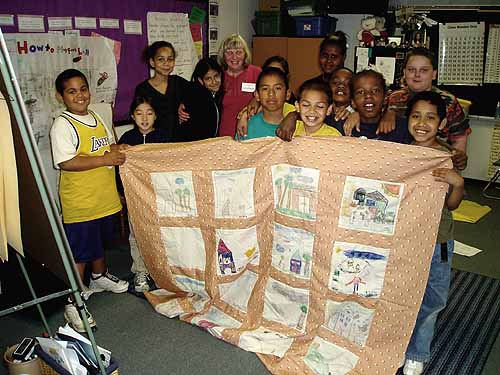
Karin DuPaul is surrounded by Ms. Kressin’s
Dayton’s Bluff Elementary third grade class. They proudly display the
quilt they made for Karin.
|
By Karin DuPaul, Dayton’s
Bluff Community Organizer
This is the third in a series of articles about the
Elder’s Wisdom, Children’s Song project under the leadership of Larry
Long at Dayton’s Bluff Elementary School. The students worked on the
state standards for speaking, listening, reading and writing during the
process. Larry Long led the children as they practiced interviewing
skills and talked about the importance of learning and respecting the
elders of the community.
I went to visit the class and thank the children for the
beautiful job they did when they chose me as their elder. The children
read their story about me and sang the song about me “Pick Up, Pick
Up”. The children said they had a big surprise for me. They give me a
present wrapped in paper that reminded them about National Night
Out. Inside was a beautiful quilt that they made for me. Each
child had created a square to represent parts of my life. This is a
wonderful gift that will always remind me of the wonderful experience I
had with Ms. Kressin’s third grade class. Then we had cookies and juice
and the children showed me some of their schoolwork.
Interview
My name is Karin Dorothy DuPaul. I am named after my
great grandmother, who came from Sweden. My middle name Dorothy came
from my aunt. I was born November 27, 1943. Every four or five years my
birthday is on Thanksgiving. Instead of having birthday cake I have
pumpkin pie.
I was born in South Dakota. I lived on a farm. We
had a garden and I liked to pick fresh carrots and radishes. We washed
them at the well house, and ate them. We had chickens, sheep and one
cow. We sold milk to the neighbors. When we came home from church on
Sunday we would have chicken dinner. I thought the little chicken house
would make a great playhouse, but my grandpa didn’t think so.
When I was four and a half we moved to St. Paul. My house
looked like a barn. People called it the barn house. My family included
my mom and dad, three sisters and two brothers. I went to Hancock
School in the midway area of St. Paul. I liked art and recess. The
school had tall ceilings and dark wood. I felt small in that big
building with all those people around. I went to Hancock from
kindergarten through the eighth grade. Then I went to Wilson High
School. In high school my favorite subject was history.
I guess typing was fun in the old days; we had
typewriters instead of computers. I worked in the office at a
lumberyard. That is where I met my husband. We got married in 1965. We
bought a house in the Summit University area. Then my daughter Angie
was born. I did daycare for five families. We moved to Dayton’s Bluff
in 1977.
Over the years I have worked on many projects around the
neighborhood. I wrote the first walking tour booklet because I wanted
everyone to see that Dayton’s Bluff is a great place to live. I got
interested in the history of the area and wrote more booklets so others
could learn the history. We formed a group called Upper Swede Hollow
Neighborhood Association. I also belong to a group called Friends of
Swede Hollow. We take care of the parks in the area.
I work at the Dayton’s Bluff Community Council. We started
a newspaper so people can have pride about the place they live. We also
help people organize block clubs. Block clubs work together on
projects. One project they work on is National Night Out. It is a
special night that happens every August. Neighbors get together and
celebrate the good things that are happening.
Words of Advice: Reach out to people. Treat people with
respect. Make the effort to go and introduce yourself to your
neighbors. Start a block club that works together to make the
neighborhood better and build a true community.
Song
“Pick Up, Pick Up”
(Inspired by Ms. Karin DuPaul)
I was born in South Dakota
Lived with my grandparents
when Dad went to war
When he came home
moved to Minnesota
From a small town
to the small town of St. Paul
(Chorus)
Pick up, pick up, pick up
The trash in the neighborhood
Came to St. Paul on a train, at night
Heading down the street from the railroad depot
Saw my first streetcar
Wow! Couldn’t believe it
Without railroad tracks
how could that streetcar go
(Chorus)
We found our home
on the east side of the river
In Dayton’s Bluff
a small town of it’s own
Not far from Upper Swede Hollow
This is the place we now call home
(Chorus)
It¹s a place, you can be yourself
The kind of place we are looking for
Where people seem to get along
with each other
Trust and respect. We have that more.
(Chorus)
I want you to be the best you can be
To know your neighbors
to create community
Take back the streets
plant flowers in the boulevard
Pick up the trash and junk
it’s not that hard
(Chorus)
I like to write, it’s my favorite thing
For the District Forum
the voice of community
I like to learn about things I don’t know
We will work together to make it so
(Chorus)
Words & music by Ms.
Virginia Kressin’s third grade class of Dayton¹s Bluff Achievement
Plus Elementary School and Larry Long.
Quick Fix New World
Monetary System
By Glen Mansfield
In my many years researching the cause of manmade
atrocities I discovered hunger and economic strife to be the primary
causes of most past and present crimes, revolutions and wars. In view
of this and in light of the well planned method used to cause the
horrific results of the 9-11 terrorist attack on our nation I was sure
there was more to the attack than what President George W. Bush said,
”They did it to disrupt our way of living.”
With doubts of our president’s truthfulness, I began
searching for a more realistic cause to the attack and discovered that
prior to the attack many leaders of developing countries, some with
delinquent loans to our nation’s financial institutions located in the
now downed Twin Towers, told of hunger and economic strife and asked
for more loans, but their requests were denied. This refusal led me to
believe that hunger and economic strife is what fueled the 9-11 attack.
My suspicions were reinforced when a year after the attack
an Arabic man with broken English called a radio talk show and stated,
”The Pentagon was hit because that’s where war plans are drawn and the
World Trade Center was hit because of world hunger and economic strife
and sanctions which add to that hunger and strife”.
Many believe the rich are responsible for world hunger and
economic strife but that’s not entirely so. The primary cause of world
hunger and economic strife stems from the inadequately structured
monetary system in which money is backed by precious metals, resources
and productivity. Such backing, of which many countries have little or
none of, thus produce hunger and economic strife for many people in
those countries.
Also as a result of this inadequate structure there not
only are many more people than jobs but many existing jobs pay wages
far below the cost of living, thus hunger, homelessness and economic
strife among the many unemployed and working poor. In addition to all
the above, NAFTA doesn’t work as seen in many companies relocating to
other countries, to reap the bounty of cheaper labor, lower taxes and
so on. Also, our own method of tax and spend is also a
failure as seen in the many service and program cuts. In addition to
all of the above, money breeds many murders, such as murder for
insurance, murder for inheritance and murder so the crime victim
doesn’t tell who did it.
To begin the end of all economic strife and monetary
suffering, I, an inventor of life saving devices, also invented a quick
fix modification to the monetary system which works for all people all
the time and sent it to President George W. Bush asking that he not
seek revenge nor war but that he and all leaders recognize the plight
of the world’s needy and recognize the inadequate structure of the
monetary system as being largely responsible for that plight.
Upon this recognition I asked that all leaders diligently work to enact
my proposed quick fix New World Monetary System in which money is no
longer backed by precious metal resources nor productivity but backed
on the well being of mankind, thus an abrupt end to world hunger and
economic strife. Modifying the monetary system, I wrote, is
feasible and workable.
Case in point: Long ago when world leaders
realized that the barter system didn’t work they created the monetary
system. Through the centuries the world wide monetary system has
been restructured many times to become the ill structure we have today
causing a magnitude of suffering by a multitude of people.
In spite of all the economic suffering above, and knowing
that violence only begets more violence and that terrorism will only
end upon the resolution of discontent, President George W. Bush trash
canned my peace proposal and set the world on a non-ending course of
many more deaths and destruction.
In view of this and the fact that none of the candidates
running can change anything, I find it necessary to seek the elective
office of President.
In holding that office, I will invite all leaders to
swiftly work with me in modifying the monetary system in which money is
no longer backed by material things as it is today but backed on the
well being of mankind. This backing of their New World Monetary System
will open the doors to a New World Bank.
Once the Bank is created, world leaders, after their
fiscal tax and spend, can submit their countries’ domestic economic
shortfalls to the governors of the Bank who will print and grant the
money requested. Money from the Bank will assist leaders and the public
in paying off all debts owed in the old system of today, and will
enable leaders of developing countries to buy goods from industrialized
nations in order to modernize their countries thus ensuring jobs and a
strong economy in all countries.
Money from the Bank will also enable leaders to provide
the public with free education plus affordable dental and medical. The
Bank will also enable leaders to enact a full employment program plus
provide supplemental checks for today’s low-income earners thus
increasing their income to meet the cost of living, thus an abrupt end
to world hunger and economic strife, thus a great reduction in today’s
many crimes, terrorist acts, revolutions and wars.
While world leaders are working on the details of the New
World Monetary System, I will enact my conventional platform in which
the government will do more to assist inventors with designing,
manufacturing and marketing their product or device. Thus many
new consumer goods will be created which will spur consumer spending,
thus jobs and a strong economy.
My platform also addresses the world’s exceedingly high
population and urges planned parenthood. It also calls for an end to
the development of virgin lands and calls for total recycling and has
an aggressive energy and transportation program.
My platform also calls for the people of Palestine and
Israel to seek not revenge but a future in dividing the land in dispute
so all can live in peace as good neighbors. As for Iraq, the people who
want to govern the country should write their platform for the office
sought and let the people vote. Assuming there is peace throughout the
campaign process, U.S. troops should pull out and stay out as long as
there is peace. With Best Wishes for
World
Peace,
Glen Mansfield
Dayton’s Bluff resident, inventor and former candidate for mayor of
St.Paul
Meet the Candidate
Join
Glen Mansfield
for an
Afternoon of Entertainment and Enlightenment
Sunday July 11, 2004
2 p.m. Free
Mounds Theatre
1029 Hudson Road
Saint Paul, MN 55106
Writer Susan Williams - no
happily ever after
By J. Wittenberg
When I sat down with the writer Ms. Susan Williams to
characterize her fictional stories, she told me they were “happy as
hell.”
Indeed, one review trumpeted their prevalence of gloom.
Her most recent work involves a biracial man falling in love at
mid-life.
“I would have an easier time getting published if my
stories had happier, lighter endings,” Ms. Williams said. The Great
River Review recently published her fiction in April.
Since 1988, Ms. Williams has been teaching at our own dear
Metropolitan State University, including freshman writing, the short
story, and introduction to creative writing. She has also instructed at
the Loft on and off for the past 5 years. Her writing has been
published by Nimrod Press, and in 2003, she placed 2nd in that
publication’s annual fiction contest.
“They flew me down to Tulsa, where I was wined and dined,”
Susan said, before adding – “ I visited the rich homes of would-be
writers.”
It turns out a New York agent read her story in Nimrod and
was interested in her work, but concluded at last that it was “too dark
and disturbing.”
“There’s no money in short stories, unless it is a novel
in stories,” Susan declared.
Ms. Williams has also published her poetry in New Rivers
Press in 1987, and she won the MN Voices Award with her collection
called Dying Old and Dying Young.
Ms. Williams is also currently in the mix to win the ‘Fish
Contest’ in County Cork Ireland. Indeed, this woman’s work has
Continental reach!
Susan’s greatest inspirations are Alice Munro, Joan
Didion, and Roland Flint. She received her Masters of English at the U
of M, where she has also taught at the night school. Ms. Williams has
worked in business as an editor, and she’s performed weekly book
reviews for Minneapolis Public Radio, from 1987-92, before returning to
teaching at Metropolitan State.
Of her students today at Metropolitan State, she said –
“It is the unlikely ones who often turn out to be very talented
writers; the ones who don’t think they’re all that good. But writing
overall, is not improving with the personal computer. Out of an average
of 22 students in a writing class, two or three have a real spark. Most
do not write very well, it’s a whole different era now.”
Susan mentioned that more public readings should be
offered at Metropolitan State, but conceded that “building an audience
is a slow process.” She suggested that our fine paper should be the
steadfast announcer of such events. Indeed, with all cultural
differences aside, for any community’s true progress to be declared,
literature and literacy must take a higher place in our daily lives.
Ms. Williams is forging on as a writer and I hope more
accolades come her way. She is appearing again in the spring/summer
issue of the Great River Review, which contains her latest work called
The Visit. I recommend you seek out her work at any independent
bookstores, which do need your business. And indeed, delve into the new
Metropolitan State library, and see if this fine new resource offers
any of her work.
“I’m dying to retire,” Susan declared. “The sooner the
better. I want more time just to write.”
Marian Center honors WW II
veterans at special ceremony
|
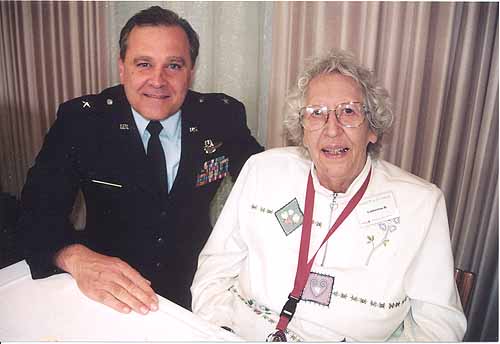
Above: Brigadier General Mark Ness,
Commander, MN Air National Guard with Catherine “Kay” Brueggeman.
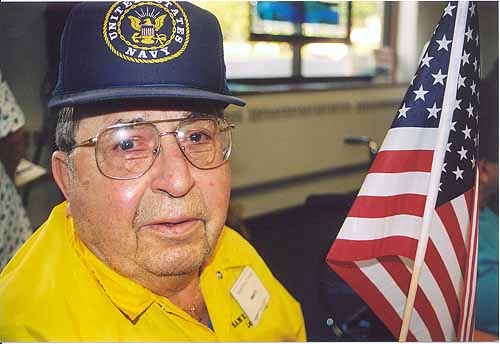
Below: WWII Veteran Rudy Schovanec.
|
|
There wasn’t a dry eye during the playing of
Taps. These courageous men and women, who fought in World War II, wiped
away tears during an emotional tribute held at HealthEast Care Center
and Residence - Marian of St. Paul at 200 Earl Street. It was standing
room only at the special Memorial Day ceremony honoring about 50 WWII
veterans who live at the Marian Center and Residence.
Their frail hands clung tightly to the American
flag, which they so bravely struggled to defend 60 years ago. These
veterans, who fought on the beaches of Normandy to the battlefields in
the Pacific, sat side by side, many in wheelchairs and in poor health.
Among them: a general, a cook, a gunner, a medic, a nurse and a pilot.
They are among the rank of 73,000 remaining WWII veterans in Minnesota.
Commander of the Minnesota Air National Guard, Brigadier
General Mark Ness, told the veterans gathered at Marian, “You answered
the call. You gave service to your country. This country is stronger
because of you. You are the heroes among us.” One by one, he called out
their names during a special roll call and they were handed a flag.
They also observed a moment of silence for the veterans from the Marian
Center who had died.
During the ceremony, they gave a send-off for Catherine
“Kay” Brueggeman, a Marian independent-living resident and WWII
veteran. Brueggeman was a Lieutenant in the Army Corps of Nurses and
served at the front lines during WWII. This Memorial Day, she was
privileged to be an honoree at the World War II Memorial dedication
ceremony in Washington, D.C. on May 29. During Kay’s visit, First Lady
Laura Bush gave Kay a personal tour of the White House.
Brueggeman told her fellow veterans at Marian that as long
as she lives she’ll remember the casualties she treated from a German
prison camp. Here were young men whose legs and arms had been amputated
by the Germans because the men had complained about a sore foot or an
arm injury. She said, “This cruelty of war has stayed with me all these
years.”
Other veterans shared their wartime memories as well. One
veteran recalled how they picked him off the battlefield and told him
he would never live to see his grandchildren. The aging veteran told
the group at Marian that he sure “fooled them.”
During the special event, the local veterans watched
videos of WWII battles, listened to music from the 1940s and enjoyed
snacks reminiscent of that era, including a special cake made from a
World War II recipe without butter or eggs.
HealthEast Care
System is a community-focused, non-profit health care system.
Locally owned and
operated, HealthEast is the largest health care provider in the Twin
Cities’ East Metro area with approximately 7,500 employees
and more than 1,300 physicians on staff.
Volunteering
at the Marian Center
We are seeking caring individuals of all ages and
groups to spend some time with our Elders. Whether you have an hour or
two, or several hours of time you can donate per month, we’d love to
hear from you. Here’s what we currently have to offer:
Visiting or reading 1 to 1 with our Elders
Beauty Shop Helpers
Chapel Services Helpers
Recreation Programs Assistants for
Arts and Crafts and/or Group
Activities
Musical Entertainers (singers, play the
piano or organ, or any musical
instrument)
Men’s Discussion Group Leader
Grocery Shopping Helper
And so much more!
Are you a High School student? You can get credit for
volunteering! Many schools require a number of hours in “Community
Service”. By volunteering at our facility, you will get extra credit,
gain experience in Senior Care, contribute to the community and have
fun ... all at the same time.
Volunteering is very rewarding to every one of
all ages and opens opportunities you never dreamed of.
If you are interested in joining our wonderful team of
volunteers, please contact Robert Johnstone, Volunteer Services
Coordinator at (651) 793-2116.
Thank
you from the Community Council
The Dayton’s Bluff Community Council’s computer crisis is
solved. For the past several weeks, staff computers were
ineffective and not working. Thanks go out to Deluxe Carpet
Company on East Seventh Street and a few other neighborhood businesses
for making monetary contributions to help the organization purchase new
and upgraded computers and parts. With the new and
efficient computers, staff are able to go back to their normal
operation.
The Dayton’s Bluff District 4 Community Council is a
community-based non-profit organization located in Dayton’s Bluff, St.
Paul with the mission to advocate for the community, advise government,
provide information, and undertake action to promote, cultivate, and
set in motion conditions, programs, and ideas for the recreational,
housing, educational, economic, and social needs for the betterment of
the community. The organization provides programs and services
such as crime prevention, citizen participation, recycling,
neighborhood clean up, code enforcement, green space, buckthorn
removal, business entrepreneur classes, and neighborhood home tours to
the community.
If you would like to make a contribution to support the
organization and its efforts, please send your tax-deductible donation
to, 789 East Seventh Street, St. Paul, MN 55106. We are
also looking for board and committee members. If you have some
spare time and want to make a difference, contact us at
651-772-2075. Community of color members are strongly encouraged
to participate.
To learn more about the Dayton’s Bluff Community Council,
please visit our website at: www.daytonsbluff.org
Remembering
President Ronald Reagan
By Nachee Lee
When I came to this country in the 1980s I had no idea who
Ronald Reagan was. The first time I saw him on TV, as a new
refugee who didn’t understand or speak a word of English, by the look
of Reagan’s face and presentation my instinct told me that he would be
special and a lot of people would like and respect him. Later, I
learned that he was the president of this country, and he was also a
movie star.
Since I’ve learned more about Ronald Reagan I started to
watch some of his movies. As a young person I always idolized and
was intrigued by cowboy movies. Ronald Reagan is one of my cowboy
idols next to Paul Newman. Personally, I’m not a person who is
involved much in the political arena, but I believe that Reagan had set
a new precedent for the Republican Party. In my spiritual belief, only
good and holy people tend to live and have a long life. Reagan
had lived 93 years on earth. To me, this says a lot.
On Friday, June 11, 2004, I showed my honor and respect to
Ronald Reagan by thinking about him while I was passing out flyers in
the neighborhood. Many people might have taken that day off from work
to honor him, but I had to inform the residents at Third Street and
Griffith about a housing plan for the vacant lot next to Parkway Little
League. The housing plan is to build four new homes at the lot.
|